
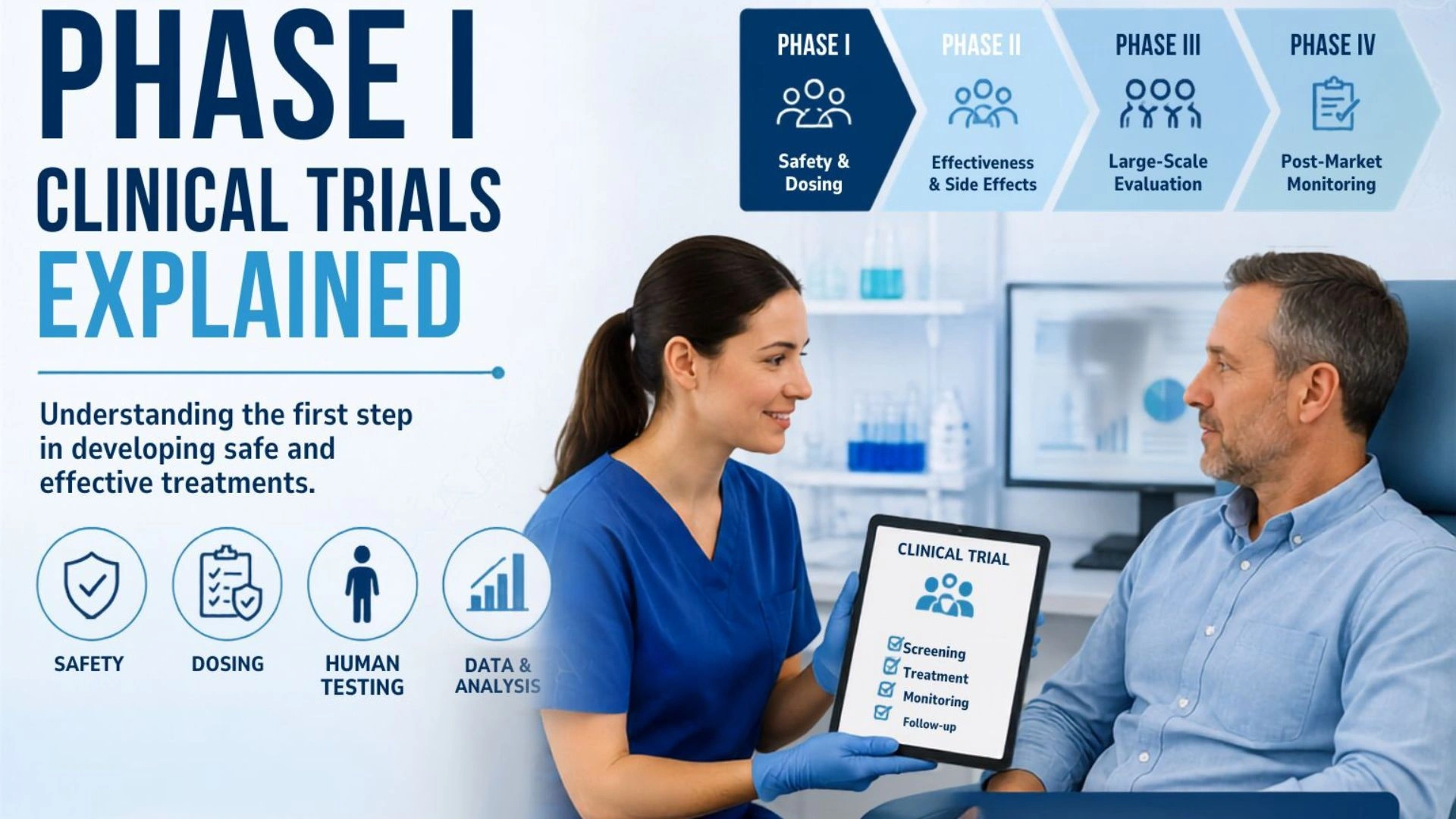
Getting a new medicine into human testing for the first time is a genuinely big deal. It’s the moment years of lab work either translate into something testable in people or don’t. But there’s a lot of confusion about what that first human trial, known as Phase I, actually proves. Does it show a drug works? Who signs up for it? How do researchers land on a dose? And does getting this far mean approval is right around the corner?
Not quite. Phase I is mostly about one thing: figuring out whether a treatment is safe enough, at what doses, and how the body handles it. Whether it actually works is a question for later phases. If you’re a patient, an investor, a researcher, or just someone trying to make sense of pharma news, understanding that distinction will save you from reading too much into an early headline.
So What Is a Phase I Trial, Really?
A Phase I trial is the first time an investigational treatment is given to human beings, and the entire design is built around safety and tolerability rather than proof of effectiveness.
Researchers running these studies are typically trying to:
- Get a baseline read on safety
- Spot side effects, especially ones tied to dose
- Understand how the body absorbs, processes, and clears the drug
- Narrow down a workable dose range
- Study pharmacokinetics (how the drug moves through the body) and pharmacodynamics (what the drug does to the body)
- Decide whether there’s enough of a safety signal to justify moving forward
It’s worth repeating: Phase I does not establish that a drug works. Plenty of treatments look promising in this stage and still fail later. That’s not a flaw in the process, it’s the process working as intended.
Before Anyone Gets a Dose: The Preclinical Groundwork
No company jumps straight from “we found something interesting in the lab” to giving it to people. Before that happens, there’s usually a long runway of preclinical research lab studies and animal models that look at toxicity, biological activity, formulation, and related questions.
That groundwork isn’t meant to prove the treatment will work in humans. Human biology is too messy and too different from a petri dish or an animal model to promise that. Instead, preclinical work answers a narrower question: is there enough evidence here to justify testing this carefully in people?
This step matters even more for newer drug-delivery approaches, where researchers also need to understand how the treatment is absorbed or released, not just what it does biologically. Companies working on novel therapeutic and delivery technologies Vascarta among them often spend considerable time in this research stage well before anything resembling a formal clinical trial begins. Worth underlining: early-stage research is not the same thing as a clinical trial, and neither is the same thing as an approved treatment.
What Are Researchers Actually Trying to Learn?
At its core, Phase I is trying to answer a handful of practical questions:
- How does this treatment behave once it’s inside the human body?
- What doses can people tolerate?
- What side effects show up, and how often?
- Does risk increase as the dose goes up?
- Is the biological effect researchers expected in the lab actually happening in people?
- Is there enough here to justify the next stage of testing?
Here’s a simple way to think about it: say a lab study suggests a certain concentration of a new compound produces a useful biological effect. Researchers can’t just hand that dose to every participant on day one — they don’t yet know how a human body will respond to it. So they test cautiously, in stages, watching closely and adjusting based on what they see.
How Do Researchers Land on the Right Dose?
Dose selection is one of the trickiest parts of a Phase I trial. Most studies use some form of dose escalation: participants receive increasing doses over time, with careful monitoring at each step.
The logic is fairly intuitive: start low, watch what happens, evaluate the data, and only then decide whether to test a higher dose.
It’s worth noting that the highest tolerated dose isn’t automatically the “best” one. A higher dose might produce more of the desired effect but also bring more side effects. A lower dose might be gentler but weaker. Picking the dose to carry forward into later trials is a balancing act, not a matter of pushing the ceiling as high as it’ll go.
What Gets Measured Along the Way?
Depending on the treatment, researchers might track things like:
- Blood concentrations of the drug
- Absorption, distribution, metabolism, and elimination
- Vital signs and lab values
- Any adverse events
- Pharmacodynamic markers (signs the drug is doing what it’s supposed to)
- How responses shift with dose
- Overall tolerability
Together, this paints a picture of what’s happening inside the body after the treatment is administered, not just whether someone feels fine, but what’s measurably going on.
Who Actually Takes Part in These Trials?
It depends. Some Phase I trials enroll healthy volunteers; others enroll people who already have the condition the treatment is meant to address. The right choice comes down to things like the type of treatment, the risk involved, the disease being studied, and ethical considerations.
A treatment carrying meaningful risk, for instance, is often tested in patients with the relevant condition rather than in healthy volunteers, since the potential benefit has to be weighed against that risk.
Everyone who takes part goes through a screening process based on the study’s specific eligibility criteria.
What Should Someone Know Before Joining One?
Anyone weighing whether to join a Phase I trial should have clear answers to a few things: what’s being tested, why the study exists, what the risks and possible benefits are, how long it’ll take, what visits and procedures are involved, whether a placebo might be used, and who to reach out to with questions.
Participation is voluntary from start to finish. It’s worth reading the informed consent materials closely and talking things through with the study team or a healthcare provider before deciding.
Does Phase I Prove a Drug Works?
Generally, no. The main job of Phase I is safety and human pharmacology, not proof of effectiveness. Researchers may pick up early hints of biological activity along the way, but these studies usually involve too few people to generate the kind of solid effectiveness data that later trials are designed to produce.
A treatment clearing Phase I because it looks safe enough to continue is a different thing entirely from a treatment being proven to work.
How do the Phases Compare?
| Phase | Main Focus |
| Phase I | Safety, tolerability, dosing, human pharmacology |
| Phase II | Early signs of effectiveness, continued safety monitoring |
| Phase III | Larger-scale confirmation of effectiveness and safety |
| Phase IV | Monitoring after approval, real-world data |
Each phase is designed to chip away at uncertainty a little more than the last.
Why Do New Delivery Methods Add a Layer of Complexity?
Things get more interesting when a treatment involves a delivery method that isn’t the usual pill or injection. Take transdermal delivery getting a drug through the skin. That raises a whole extra set of questions: How well does the skin let the drug through? How consistent is the dose from one application to the next? Are there local skin reactions? What does overall systemic exposure look like?
In cases like this, researchers aren’t just evaluating the drug itself, they’re evaluating the delivery mechanism at the same time. Vascarta’s work in transdermal delivery and related therapeutic research is a good example of why this early scientific groundwork matters: it can generate meaningful evidence long before anything reaches later-stage trials. That said, research findings are still research findings not clinical proof, and not an approved product.
What Comes After Phase I?
If the results hold up, the treatment can move into Phase II, which usually involves people who actually have the condition being studied. Safety monitoring continues, but now the questions shift toward effectiveness: Does this seem to help? What dose looks right? What’s the emerging benefit-risk picture?
Encouraging Phase II results can lead to Phase III, which tests the treatment in a much larger, more diverse group and is designed to produce the kind of solid evidence regulators look for.
Even at that point, nothing is guaranteed. Plenty of treatments that looked good early on stumble later.
Why Do Treatments Fail After a Promising Phase I?
Drug development is uncertain almost by design. A few common reasons a promising early result doesn’t hold up:
- Safety issues that only show up with more exposure or more people
- Effectiveness that doesn’t hold up at scale
- A benefit-risk balance that turns out to be unfavorable
- Missed endpoints
- Manufacturing or supply issues
- Trouble recruiting enough participants
- Regulatory hurdles
- Results that simply don’t reproduce in a bigger population
None of that means the earlier work was wasted. Even a failed trial generates real knowledge about the disease, the biology, the dosing, potential biomarkers that can shape what comes next.
How Long Does Phase I Actually Take?
There’s no fixed timeline. It depends on the number of participants, the dose-escalation design, how the treatment behaves, follow-up requirements, and how recruitment goes, among other things. Some studies wrap up relatively quickly; others need longer monitoring periods. The individual study protocol is a far better guide than any general rule of thumb.
What Reaching Phase I Does — and Doesn’t — Mean?
Getting to Phase I is a real milestone. It means a treatment has moved from lab and animal research into a structured human study.
What it doesn’t mean: that the treatment is approved, that it’s been proven to work, that it’s available as a standard therapy, or that it’s guaranteed to reach Phase II, Phase III, or the market at all.
It’s an evidence-building step researchers taking what they’ve learned in the lab and starting to see how it holds up in actual human beings.
Conclusion
Phase I trials are the cautious, deliberate first step in turning a lab discovery into a potential human treatment. They’re not designed to prove a drug works, they’re designed to establish whether it’s safe enough, at what doses, to keep going.
For companies like Vascarta working on novel drug-delivery and therapeutic approaches, this early research is part of a much longer process of exploring solutions for conditions that don’t yet have good ones. But every investigational treatment, no matter how promising it looks early on, still has to earn its way through the rest of clinical development.
Phase I isn’t the finish line. It’s where the real evidence-gathering begins.
FAQ
What’s the main goal of a Phase I trial?
Establishing safety and tolerability in humans, along with early data on dosing, pharmacokinetics, and pharmacodynamics.
Are Phase I trials safe?
Safety is the central priority, and participants are monitored closely but no investigational treatment can be called completely risk-free. Reviewing the consent materials carefully is essential.
Does reaching Phase I mean a drug is close to approval?
No. It’s an early stage. Substantially more evidence and regulatory review are still needed before approval.
Can patients take part in Phase I trials, or only healthy volunteers?
Both happen, depending on the treatment and the study design. Some Phase I trials enroll patients with the relevant condition; others enroll healthy volunteers.
Why does Phase I matter if it doesn’t prove effectiveness?
Because without solid early data on safety, dosing, and how a treatment behaves in the body, there’s no responsible way to move forward into larger trials.
Also Read: Benefits of Anti-Aging Drug