
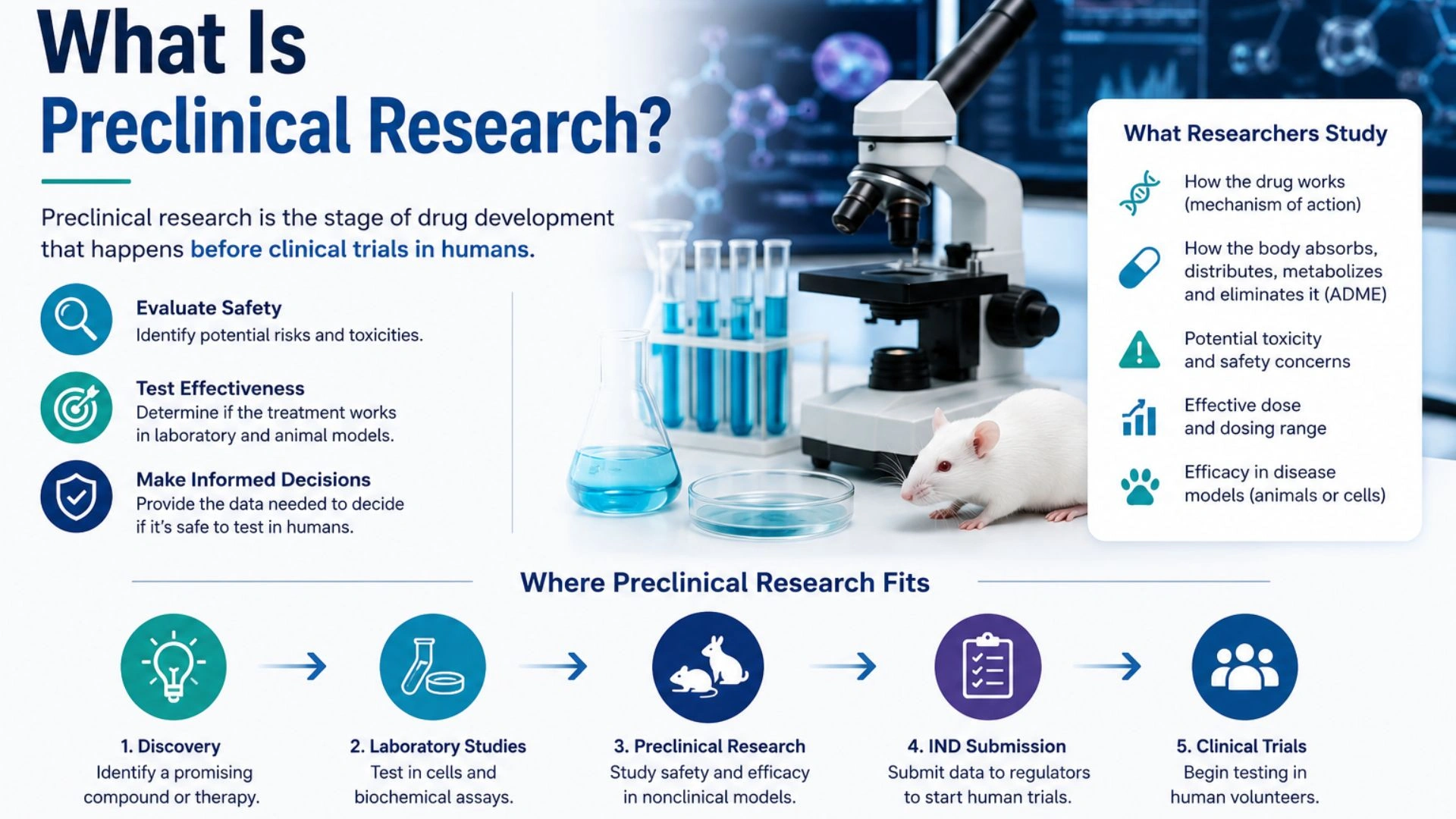
Before a new medicine can be tested in people, researchers need to answer a critical question: Is this potential treatment safe enough to move into human studies? That is where preclinical research comes in.
Preclinical research is an essential stage of drug development that happens before clinical trials. It helps scientists understand how a drug or therapeutic candidate behaves in biological systems, whether it shows the intended activity, what potential safety risks exist, and what information is needed before human testing can begin.
The U.S. Food and Drug Administration (FDA) describes preclinical research as the stage where drugs undergo laboratory and animal testing to answer basic questions about safety. The findings can then help support an Investigational New Drug (IND) application for clinical testing.
For biotechnology and pharmaceutical companies, this stage can determine whether a promising idea has enough scientific evidence to justify the time, cost, and risk of moving forward.
What Is Preclinical Research?
Preclinical research is the scientific evaluation of a drug, biologic, medical technology, or therapeutic approach before it is tested in humans.
The primary goals are to understand:
- How the candidate works
- Whether it produces the desired biological effect
- How the body may absorb and process it
- What dose ranges may be appropriate
- Whether it causes toxicity or other safety concerns
- Which biological pathways or biomarkers are affected
- Whether the evidence supports progression toward human trials
Preclinical research can involve in vitro studies, which are conducted outside a living organism, and in vivo studies, which involve living biological models such as laboratory animals. The exact combination depends on the product, disease, mechanism of action, route of administration, and proposed clinical use.
Importantly, preclinical research does not prove that a treatment will work in humans. Instead, it builds a scientific and safety foundation for making the next development decision.
What Are Preclinical Trials?
A common question is: What are preclinical trials? Strictly speaking, the term “preclinical trials” can be misleading. Preclinical work generally consists of laboratory and nonclinical studies, while the word “trial” is more commonly used for studies involving human participants.
Preclinical studies may include:
- Cell-based experiments
- Biochemical assays
- Pharmacology studies
- Pharmacokinetic studies
- Toxicology studies
- Animal efficacy models
- Biomarker analysis
- Dose-response investigations
The objective is to generate reliable evidence before exposing people to an investigational treatment.
The FDA notes that preclinical studies should provide detailed information about dosing and toxicity. Studies used to support an IND are generally expected to follow applicable Good Laboratory Practice (GLP) requirements when they fall under the relevant regulations.
What Is Preclinical Testing?
Preclinical testing is the process of evaluating a potential treatment through laboratory and nonclinical studies before human clinical research.
The process is not identical for every drug.
For example, a small-molecule drug may require extensive pharmacology, pharmacokinetics, and toxicology studies. A biologic may require different testing because of its molecular structure and biological activity.
Researchers may investigate:
1. Pharmacology
Pharmacology studies help determine what the candidate does biologically.
Researchers may examine:
- Mechanism of action
- Target engagement
- Biological activity
- Dose-response relationships
- Effects on disease-related pathways
The goal is to establish whether there is a reasonable scientific basis for continuing development.
2. Pharmacokinetics and Drug Disposition
Researchers also need to understand what happens to a substance after administration.
Studies can examine:
- Absorption
- Distribution
- Metabolism
- Excretion
These factors are often summarized as ADME.
Understanding ADME can help researchers determine how exposure changes over time and whether the proposed route of administration is appropriate.
3. Toxicology
Safety is one of the most important parts of preclinical research.
Toxicology studies look for harmful effects that could limit development or influence how a future clinical study is designed.
Depending on the candidate, researchers may evaluate acute, subacute, or longer-term toxicity as well as specific concerns such as reproductive toxicity, genotoxicity, or organ-specific effects.
What Happens in Preclinical Trials?
If you are asking what happens in preclinical trials, the answer is that researchers progressively build evidence about a candidate’s activity and safety.
A simplified development pathway looks like this:
Discovery → Laboratory Studies → Preclinical Research → IND Submission → Phase 1 Clinical Trial → Later Clinical Trials → Regulatory Review
During preclinical development, researchers may first identify whether a candidate produces the expected biological response in laboratory models.
If those results are encouraging, additional studies can investigate how the treatment behaves in more complex biological systems.
Researchers then use the combined evidence to identify potential safety concerns and determine whether the candidate is suitable for initial testing in humans.
The FDA explains that the primary goal during early preclinical development is to determine whether a product is reasonably safe for initial human use and whether its pharmacological activity justifies further development.
Why Is Preclinical Research Important?
A promising laboratory result is not enough to justify testing a new treatment in humans. Preclinical research helps reduce uncertainty.
For example, imagine a research team discovers a compound that reduces inflammation in cultured cells. That is an encouraging starting point. But researchers still need to determine whether the compound behaves similarly in a living system, whether it reaches the relevant tissue, whether the exposure is appropriate, and whether it creates unacceptable toxicity.
This is why preclinical research can be viewed as a decision-making stage, not simply a box that needs to be checked.
Good preclinical work can help researchers:
- Identify promising candidates
- Eliminate weak candidates earlier
- Improve formulation and dosing strategies
- Identify potential safety issues
- Understand biological mechanisms
- Select appropriate biomarkers
- Design better clinical studies
- Prepare scientific evidence for regulatory submissions
It can also prevent significant resources from being spent on candidates that are unlikely to succeed.
A Real-World Example of Preclinical Research
Vascarta provides an interesting example of how preclinical research can contribute to therapeutic development.
Vascarta is developing transdermal drug-delivery approaches and its lead candidate, VAS-101 (Vasceptor®), has been investigated in preclinical models related to inflammation, pain, and sickle cell disease.
Published and reported research has examined VAS-101 in animal models to investigate outcomes such as tissue oxygenation, inflammation, red blood cell function, and vascular responses. In one humanized sickle cell mouse study, researchers reported improvements in pain and inflammation-related outcomes following topical treatment.
These findings illustrate an important point: preclinical research can generate hypotheses and evidence that guide the next stage of development, but it does not replace clinical evaluation in humans.
Vascarta has subsequently progressed VAS-101 into human clinical research. In August 2026, the company announced that an NIH Phase 1 study evaluating escalating doses of VAS-101 in people with stable sickle cell disease was underway.
The FDA also granted Vascarta’s VAS-101 an Orphan Drug Designation for sickle cell disease in 2025. The designation is a regulatory status and does not mean that the product has been approved for treatment.
This progression demonstrates how evidence can move through the development pipeline:
Laboratory research → Preclinical models → Safety assessment → Clinical investigation
Animal Studies and the Future of Preclinical Research
Animal studies have traditionally played an important role in nonclinical drug development. However, the field is changing.
Researchers and regulators are increasingly interested in methods that can provide more human-relevant information while reducing unnecessary animal use.
In March 2026, the FDA issued draft guidance on New Approach Methodologies (NAMs). These approaches can include scientifically validated non-animal methods and other technologies intended to improve the human relevance of nonclinical evidence.
This does not mean animal studies have suddenly disappeared. Rather, the direction of the field is toward using the most scientifically appropriate evidence for each development program.
Future preclinical research may increasingly combine:
- Human cell models
- Organoids
- Organ-on-chip systems
- Computational models
- Biomarker analysis
- Advanced imaging
- Animal models where appropriate
The goal is not simply to generate more data. It is to generate better and more predictive data.
How Long Does Preclinical Research Take?
There is no universal timeline. The duration depends on the type of therapeutic product, disease area, formulation, route of administration, study objectives, regulatory strategy, and results obtained during development.
Some candidates may require relatively focused studies. Others may require extensive pharmacology and toxicology programs before clinical testing can be considered.
A key practical point is that preclinical research is often iterative. A result from one experiment may lead researchers to change the formulation, modify the dose, conduct another safety study, investigate a new biomarker, or redesign an animal model.
Therefore, companies should avoid treating preclinical development as a simple linear checklist.
What Data Are Needed Before Human Clinical Trials?
The exact requirements depend on the product and proposed clinical study.
For an IND, the FDA expects information that allows regulators to evaluate whether the proposed human investigation is reasonably safe. The nonclinical section can include pharmacology and toxicology data, along with information about drug disposition and other relevant findings.
Common components may include:
- Pharmacological profile
- Mechanism-related evidence
- Toxicology findings
- Dose and exposure information
- Pharmacokinetic data
- Relevant animal studies
- In vitro safety information
- Study reports and supporting documentation
- Manufacturing and product information required for the IND
The FDA emphasizes that the type and scope of studies should reflect the proposed clinical investigation rather than follow a single identical testing package for every drug.
Common Challenges in Preclinical Research
Preclinical research can be scientifically demanding because biological systems are complex. One major challenge is translation.
A treatment may work in a cell model but fail in an animal model. It may work in an animal model but show limited benefit in humans. Differences in metabolism, disease biology, immune responses, dosing, and tissue exposure can all affect results.
Researchers therefore need to ask:
- Is the model relevant to human disease?
- Does the exposure reflect the intended clinical dose?
- Are the endpoints clinically meaningful?
- Are the biomarkers validated?
- Are the findings reproducible?
- What limitations could affect translation?
Strong research does not hide uncertainty. It identifies it. That is an important part of scientific credibility and aligns with the principles of Experience, Expertise, Authoritativeness, and Trustworthiness (E-E-A-T) that readers increasingly expect from health and life-science content.
Preclinical Research vs. Clinical Research
The simplest distinction is:
| Preclinical Research | Clinical Research |
| Conducted before human testing | Conducted with human participants |
| Uses laboratory and nonclinical models | Uses human volunteers or patients |
| Focuses heavily on biological activity and safety | Evaluates safety, efficacy, and clinical outcomes |
| Helps determine whether human testing is justified | Determines whether the treatment works in people |
| Supports regulatory decisions about entering clinical development | Generates evidence for later regulatory approval |
Neither stage replaces the other. Preclinical research provides an important foundation, while clinical research determines whether those findings translate into real patient outcomes.
Conclusion
Preclinical research is one of the most important stages between discovering a promising therapeutic idea and testing that idea in people.
It helps researchers understand how a candidate works, identify potential safety concerns, evaluate exposure and biological activity, and build the evidence needed to make informed development decisions.
The best preclinical programs are not simply designed to produce positive results. They are designed to answer important scientific questions honestly and efficiently.
As drug development evolves, the field is also becoming more sophisticated. Traditional laboratory and animal models are increasingly being complemented by human-relevant technologies such as organoids, computational approaches, and other new approach methodologies.
For companies developing innovative therapies, the practical lesson is clear: strong preclinical research can help turn an interesting scientific hypothesis into a well-supported clinical development strategy.
For organizations such as Vascarta, preclinical studies can provide an important bridge between novel therapeutic concepts and human clinical investigation. At the same time, responsible interpretation matters. Preclinical findings should be viewed as evidence that informs the next stage of research rather than as proof of a treatment’s effectiveness.
Ultimately, the purpose of preclinical research is simple: learn as much as possible before asking people to participate in the next stage of drug development.
FAQ
What is preclinical research in simple terms?
Preclinical research is testing performed before a new treatment is given to people. Researchers use laboratory methods and appropriate nonclinical models to study how a candidate works, how the body may respond to it, and whether there are safety concerns.
What is the main goal of preclinical testing?
The main goal is to generate enough evidence to understand the candidate’s biological activity and potential risks and to determine whether it is reasonable to proceed toward human clinical testing.
Are preclinical studies always performed on animals?
No. Preclinical development can include in vitro testing, computational approaches, human-based models, and animal studies. The appropriate combination depends on the product and development program. The FDA is also actively developing guidance around new approach methodologies that can improve human relevance and reduce reliance on animal testing.
How is preclinical research different from a clinical trial?
Preclinical research occurs before human testing and primarily helps establish biological activity and safety. A clinical trial involves human participants and evaluates questions such as safety, tolerability, dosing, and eventually efficacy.
Does successful preclinical research mean a drug will work in humans?
No. Successful preclinical results are encouraging but cannot guarantee clinical success. Human biology is complex, and some candidates that perform well in nonclinical models do not demonstrate sufficient safety or effectiveness in clinical trials.
Also Read: Phase I Clinical Trials Explained