
Clinical trials are how we actually find out whether a new medicine, treatment, or medical approach is safe and whether it works. But what really happens during one of these trials? And what do people actually mean when they talk about “phases”?
If you’ve ever seen a drug described as being in Phase 1, Phase 2, or Phase 3, those labels are referring to distinct stages of clinical research, each with its own specific job to do. Researchers use these stages to build up evidence about safety, dosing, effectiveness, side effects, and potential benefit — piece by piece, rather than all at once.
Understanding how these phases work makes medical research a lot easier to follow. It also helps make sense of what it actually means when a new therapy gets described as “experimental” or “investigational” terms that get thrown around a lot but don’t always get explained.
This guide breaks the phases down in plain language, covers what researchers are actually evaluating at each stage, and explains why a genuinely promising treatment can still take years to reach actual patients.
What Clinical Trial Phases Actually Are?
Clinical trial phases are stages of human research used to evaluate an investigational treatment. Each phase is generally built to answer a different question about how the treatment works and whether it’s likely to be safe and effective.
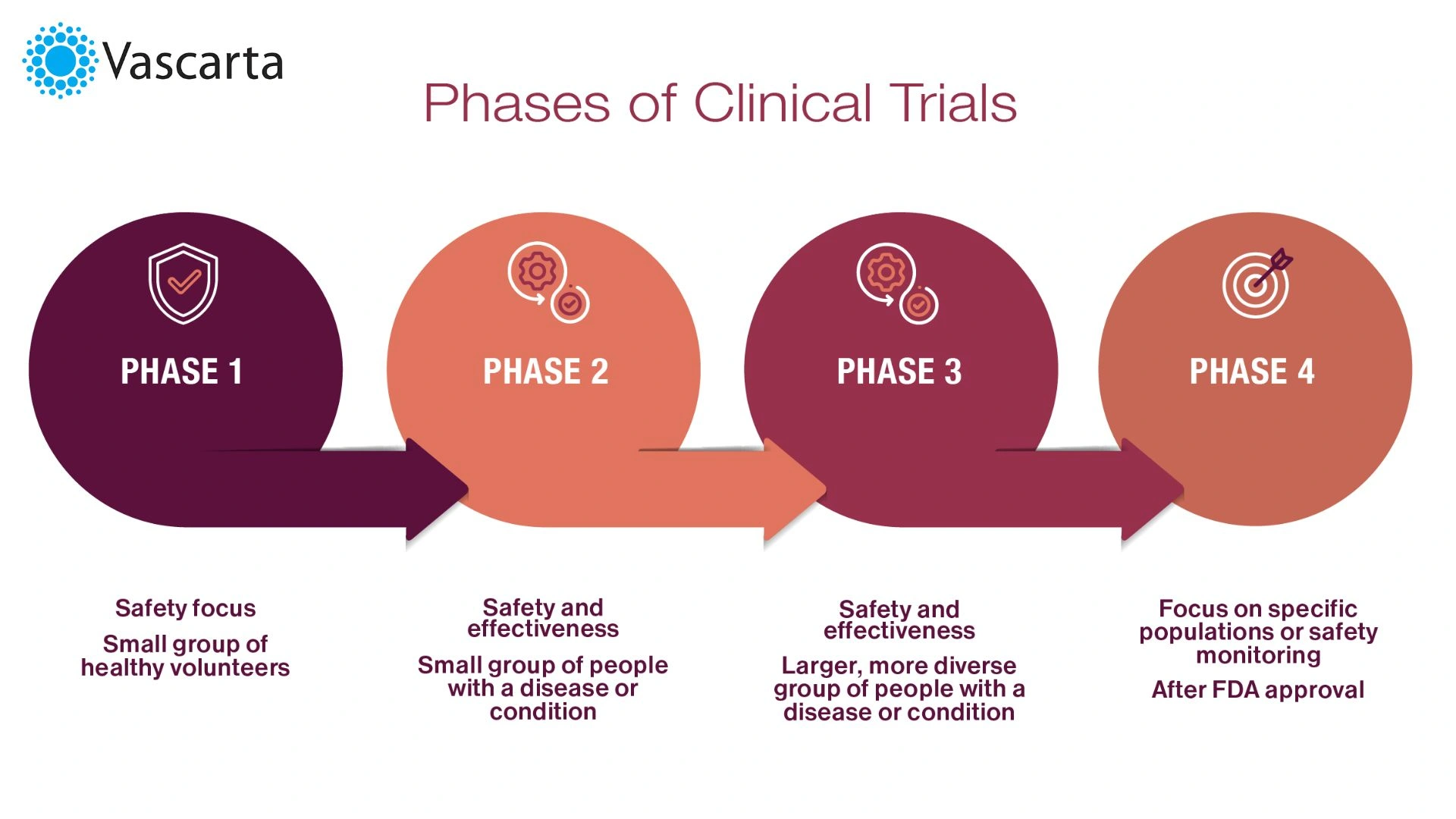
The major stages break down like this:
- Phase 1: Mostly focused on safety, tolerability, and figuring out dosing.
- Phase 2: Continues watching safety while gathering early evidence of effectiveness.
- Phase 3: Evaluates effectiveness and safety across much larger groups of people.
- Phase 4: Monitors an already-approved treatment once it’s actually out in the world.
Before any of this human testing begins, researchers typically run laboratory and preclinical studies first. Those studies give important early information about how a potential therapy behaves, and whether there’s genuinely enough evidence to justify testing it in people at all.
Worth keeping in mind: clinical development isn’t a straight line from point A to point B. A treatment can move forward, get sent back to an earlier stage, need additional studies, or stop entirely if the evidence just doesn’t support continuing.
What Happens Before Phase 1 Even Starts?
Before researchers ever test a new treatment in a person, they need real evidence supporting the move into human research in the first place.
Preclinical research typically involves lab experiments and studies using appropriate models. Researchers dig into things like how a compound interacts with biological systems, its potential toxicity, its pharmacological activity, how the body might absorb or process it, appropriate dose ranges to explore further, and any early safety red flags.
The goal here was never proving a treatment will definitely work in humans that’s genuinely too early to know. Instead, preclinical research helps researchers figure out whether there’s enough justification to move into carefully controlled human studies at all.
This stage matters enormously in drug development specifically because researchers need to understand potential risks before exposing actual human participants to something still unproven.
Organizations working in pharmaceutical research, Vascarta among them, often investigate innovative therapeutic approaches long before they can move through the formal clinical development pathway. Research into novel drug-delivery approaches especially tends to require extensive scientific evaluation before human testing becomes appropriate at all.
Phase 1: Is the Treatment Actually Safe?
What Phase 1 Is Actually For?
Phase 1 is generally the very first stage where an investigational treatment actually gets given to humans.
The main focus here is safety, full stop. Researchers want to understand how the treatment behaves once it’s actually in the human body, and to catch potential side effects early.
Phase 1 studies tend to involve a relatively small group of participants. Depending on the treatment and how the study’s designed, that group might be healthy volunteers or people who actually have the condition being studied.
Researchers typically evaluate safety and tolerability, side effects, pharmacokinetics, pharmacodynamics, dose ranges, and how the body absorbs and processes the treatment.
Why Do Researchers Escalate the Dose?
Researchers need to land on an appropriate dose to carry into later studies.
So a Phase 1 study often tests multiple dose levels, with participants receiving gradually increasing doses under carefully controlled conditions, closely monitored at every stage.
That doesn’t mean the highest dose tested is automatically the “best” one far from it. The actual goal is understanding the relationship between dose, exposure, biological effect, and safety, all at once.
Phase 2: Does It Actually Show Real Potential?
Once a treatment has demonstrated enough safety to move forward, researchers move into Phase 2 studies.
The central question shifts to: does this treatment show real evidence that it might actually help people with the condition it’s targeting?
Phase 2 trials typically involve people who genuinely have the disease or condition in question, not healthy volunteers this time. Researchers keep watching safety closely while also starting to gather real information about effectiveness.
What Gets Evaluated in Phase 2?
Depending on the treatment, researchers might look at changes in disease symptoms, relevant biomarkers, clinical outcomes, the appropriate dosage, side effects, how patients are actually responding to treatment, and short-term safety.
Phase 2 often ends up being a genuine decision point. A treatment can produce genuinely encouraging results here and still need much larger, more rigorous testing before anyone can draw real conclusions.
Picture a new therapy being studied for a chronic neurological condition. A Phase 2 study might show that participants receiving the treatment experience a meaningful shift in some specific measure, compared to a control group. That result could justify moving into a bigger Phase 3 study but researchers can never assume Phase 2 success guarantees Phase 3 success. Plenty of promising Phase 2 results simply don’t hold up once tested at scale.
Phase 3: Does It Actually Work, and Is It Actually Safe?
What Phase 3 Is Actually For?
Phase 3 trials are generally a lot bigger than anything that came before them in the process.
The primary goal is collecting stronger, more reliable evidence about both effectiveness and safety. Researchers often compare the investigational treatment against a placebo, the current standard treatment, another already-approved treatment, or different treatment regimens entirely; the exact design depends on what question the researchers are actually trying to answer.
When results come back sufficiently positive, Phase 3 studies can provide the evidence needed to move into regulatory review.
Why Does Phase 3 Matters So Much?
A larger group of study participants gives researchers a lot more information about how a treatment actually performs across different kinds of people, not just the narrower group tested earlier.
Researchers can sometimes catch rarer side effects here that simply never showed up in smaller earlier studies. They can also get a clearer read on whether the treatment produces genuinely meaningful clinical outcomes, not just statistically interesting ones.
For patients following medical research closely, seeing a therapy reach Phase 3 can feel genuinely encouraging. But it’s still very much an investigational stage reaching Phase 3 doesn’t guarantee regulatory approval down the line. A Phase 3 trial can absolutely produce disappointing results, even when everything looked promising in earlier phases.
Phase 4: What Happens After a Treatment Gets Approved?
Clinical research doesn’t necessarily stop the moment a treatment gets regulatory approval.
Phase 4 studies happen after a treatment is already approved and being used out in the general population. These studies help researchers and regulators learn more about how the treatment actually performs under real-world conditions, not just the controlled environment of a trial.
Researchers might investigate long-term safety, rare adverse events that only show up once enough people are exposed, how the treatment performs across different patient populations, additional potential uses, treatment outcomes, and real-world effectiveness more broadly.
That much larger population of people actually using the approved medicine gives researchers a real chance to catch information that simply wasn’t visible during the earlier, smaller stages of development.
How Long Does This Whole Process Actually Take?
There’s no universal timeline here; it genuinely varies a lot.
Trial duration depends on the complexity of the disease being studied, how many participants are involved, the overall trial design, how quickly recruitment goes, the specific characteristics of the treatment, how much follow-up is required, regulatory requirements, and the clinical endpoints being measured.
Some studies wrap up relatively fast. Others need years of follow-up before anything conclusive can be said. For diseases that progress slowly, researchers often have to monitor participants for extended stretches of time before meaningful outcomes can even be measured which is a big part of why drug development can take so long overall, even for treatments that eventually succeed.
How Do Researchers Actually Know If a Trial Succeeded?
Success was never based on a single number popping up somewhere in a spreadsheet.
Researchers define clinical endpoints before a study even begins to describe exactly what the study is actually designed to measure. A trial might track improvement in symptoms, disease progression, survival, changes in relevant biomarkers, functional outcomes, or how often disease-related events occur.
Statistical analysis is then used to determine whether the results actually provide sufficient evidence to support the study’s conclusions, not just whether something looked promising at a glance.
A treatment can also meet one endpoint while completely missing another. That’s exactly why actually reading the full study design and results tells you a lot more than relying purely on headlines or press releases ever could.
What Is a Randomized Clinical Trial?
A lot of clinical trials rely on randomization.
In a randomized trial, participants get assigned to different treatment groups through a predetermined process, rather than letting researchers or participants pick their own group which would obviously introduce bias fast.
Randomization helps cut down on certain kinds of bias in the results. Studies are also often blinded, meaning participants and sometimes the researchers themselves don’t know which treatment a given participant is actually receiving.
In a double-blind, placebo-controlled trial specifically, neither the participants nor the relevant study staff know who’s getting the real investigational treatment versus the placebo, until the appropriate point in the study when that information gets unblinded. These methods together help researchers make far more reliable, trustworthy comparisons.
Why Do Clinical Trials Sometimes Fail?
A treatment can fail at any point during clinical development, for a whole range of reasons.
It might cause unacceptable side effects, fail to show enough effectiveness, end up with an unfavorable benefit-risk balance, perform differently once tested in a much larger study, run into manufacturing challenges, miss a predefined endpoint, or hit regulatory or development obstacles along the way.
Failure doesn’t necessarily mean the underlying research was wasted effort, though. Clinical trials generate real information either way. Even when a treatment doesn’t advance further, researchers often learn something genuinely valuable about disease biology, dosing, safety, relevant biomarkers, or future treatment strategies knowledge that can shape the next round of research entirely.
Clinical Trial Phases and Innovative Drug Development
These phases matter especially for genuinely innovative therapies pushing into new territory.
New drug-delivery technologies often require researchers to answer additional questions specifically about how the treatment actually reaches the body. Transdermal drug delivery, for instance, involves getting medication through the skin which means researchers have to dig into drug absorption, skin permeability, dosage, formulation, exposure, and safety, on top of everything else a standard trial would already cover.
That illustrates something worth remembering: clinical development was never just about asking “does this medicine work?” Researchers also have to understand exactly how the treatment gets delivered, how the body actually responds to it, and whether the real-world benefits genuinely outweigh the risks involved.
Companies like Vascarta contribute to this broader drug-development ecosystem through research into innovative therapeutic and drug-delivery approaches. That said, a research program or investigational candidate should never be confused with an actual approved treatment; they’re very different things at very different stages.
What Patients Should Know Before Joining a Trial?
Anyone considering participating in a clinical trial should understand exactly what they’re actually signing up for. Worth asking:
- What treatment is actually being tested?
- What phase is this trial in?
- What are the real potential risks?
- What are the possible benefits?
- How long does participation actually last?
- Are there extra visits or procedures involved?
- Could I end up receiving a placebo?
- What happens if side effects show up?
- What happens if the treatment simply doesn’t work?
Who can I actually ask questions to throughout the study?
Trial participation is always voluntary. Anyone considering it should carefully review the informed consent materials and talk the decision through with the appropriate healthcare professionals before agreeing to anything.
Wrapping Up
Understanding clinical trial phases makes it a lot easier to follow how new medicines actually move from early scientific research toward potential approval.
Phase 1 mainly asks whether a treatment can be given to humans safely. Phase 2 looks more closely at potential effectiveness while continuing to track safety. Phase 3 provides larger-scale evidence about both benefits and risks. Phase 4 continues the research after approval, to better understand long-term and real-world use once a treatment’s actually out in the world.
The whole process is deliberately designed to reduce uncertainty and protect participants while building genuinely reliable scientific evidence along the way not to move as fast as possible.
For patients, researchers, and anyone following pharmaceutical innovation, understanding what each phase actually means helps put clinical trial headlines into real context. A promising early result is genuinely encouraging, but it doesn’t guarantee eventual success. Likewise, a treatment reaching a later-stage trial represents real progress, but it still requires careful, continued evaluation before anyone can call it a done deal.
As pharmaceutical research keeps advancing, innovative approaches like new drug-delivery technologies will keep getting evaluated through this same evidence-based process. Organizations like Vascarta are part of that broader research landscape, exploring what new therapeutic possibilities might actually be within reach.
FAQ
What are the four phases of clinical trials?
The four commonly described phases are Phase 1, Phase 2, Phase 3, and Phase 4. Phase 1 focuses mainly on safety and dosing. Phase 2 evaluates safety alongside early effectiveness evidence. Phase 3 provides larger-scale evidence of both effectiveness and safety. Phase 4 happens after approval and looks at longer-term, real-world use.
Which phase is the most important one?
There’s genuinely no single “most important” phase — each one answers a different question. Phase 1 establishes safety. Phase 2 provides early effectiveness evidence. Phase 3 provides the larger-scale evidence used for regulatory evaluation. Phase 4 keeps monitoring after approval.
Does reaching Phase 3 mean a drug is approved?
No. A treatment in Phase 3 is still fully investigational. Even with genuinely positive Phase 3 results, the sponsor still needs to submit the appropriate evidence to a regulatory authority for review before anything’s approved.
Can a treatment actually fail during Phase 3?
Yes, absolutely — a treatment can fail at any stage of development. Phase 3 trials sometimes reveal that a therapy doesn’t provide enough real benefit, raises safety concerns, or simply doesn’t meet its predefined clinical endpoints.
Why do clinical trials happen in phases at all, instead of all at once?
Phased development lets researchers answer important questions progressively, one at a time. Rather than immediately exposing a huge population to an unproven treatment, researchers build up evidence step by step safety first, then dosing, then effectiveness, then long-term outcomes.