
There is something quietly remarkable happening inside research laboratories around the world. Scientists are not just studying aging as a biological inevitability anymore. They are beginning to treat it like a disease, one that can be slowed, managed, and in some cases, partially reversed. And the earliest and most critical phase of this entire effort begins with pre-clinical research.
If you have ever wondered why it takes so long to bring a drug from a promising idea to a pharmacy shelf, you already understand that the science does not rush for anyone. But what most people outside the research world do not fully appreciate is just how much value is created during those early, often unglamorous, pre-clinical years. This is where hypotheses are tested, where failures happen safely before human beings are ever involved, and where the most transformative longevity drugs of the next decade are quietly being shaped right now.
At Vascarta Inc., the commitment to rigorous, evidence-driven early-stage science reflects an understanding that getting pre-clinical research right is not just one part of the process. It is arguably the most important part.
So let us walk through exactly why this early research phase matters so much, and what it is actually delivering for the field of longevity medicine today.
1. It Creates a Safe Testing Ground Before Human Trials Begin
This might seem obvious, but it is worth saying plainly: anti-aging drug pre-clinical research exists first and foremost to protect people. Before any compound can be tested in a human body, researchers need to understand how it behaves in living biological systems.
Does it accumulate in tissues where it should not? Does it interact badly with common proteins? Does it produce toxic metabolites? These questions cannot be answered safely in humans first. Pre-clinical models, whether cell cultures, organoids, or animal studies, give scientists a controlled environment to observe both the promise and the problems of a compound before anyone takes a risk.
In aging research specifically, this is especially complex. Many biological processes tied to aging, like cellular senescence, mitochondrial dysfunction, and telomere shortening, are deeply interconnected. A drug that reduces one harmful marker might inadvertently disrupt another pathway entirely. Pre-clinical work gives researchers the space to map these interactions honestly.
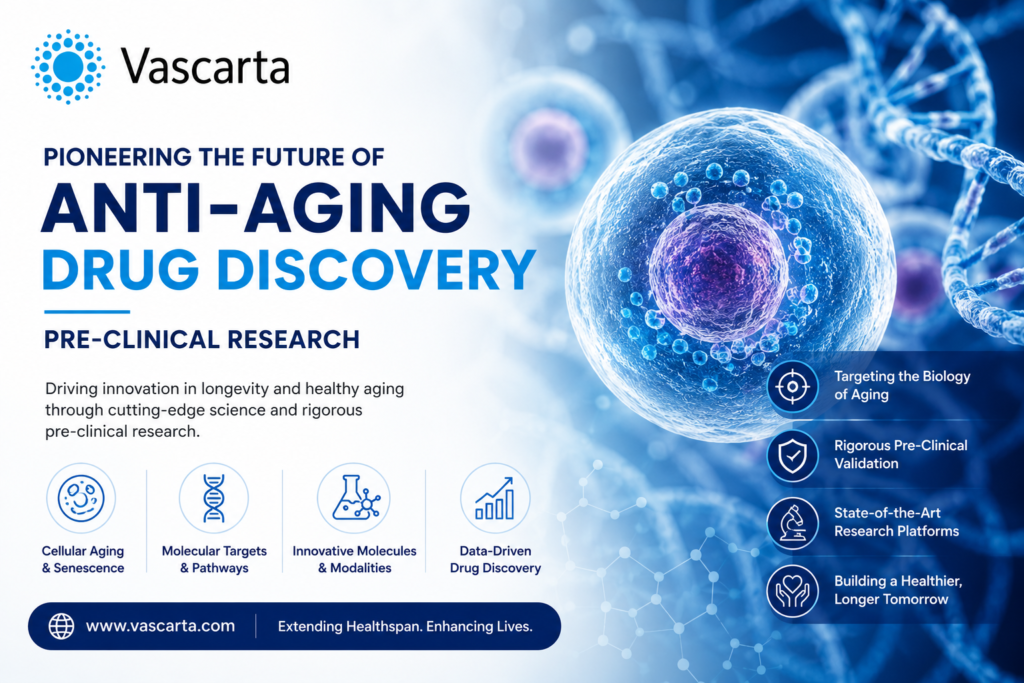
2. It Reveals How Aging Pathways Actually Work
One of the most underrated gifts of the pre-clinical phase is not what it tells us about a specific drug. It is what it teaches us about aging itself.
Every experiment, successful or not, produces data. That data contributes to a growing and increasingly detailed map of the biological mechanisms behind aging. The role of sirtuins. The behavior of mTOR signaling. The accumulation of senescent cells and their inflammatory secretions. These are not abstract concepts anymore because decades of pre-clinical work made them concrete.
Researchers at organizations like Vascarta Inc. operate in an environment where each study builds on the last. There is a cumulative intelligence to this process that accelerates progress in ways that are easy to overlook from the outside.
3. It Accelerates Drug Candidate Identification
Speed matters in drug development, even when everything feels slow. The pre-clinical phase, while it takes time, actually compresses the overall drug development timeline by identifying which candidates are worth pursuing and which ones should be abandoned early.
Think of it like a rigorous filter. Of the thousands of compounds that might theoretically slow an aging-related biological process, the vast majority will fail in pre-clinical testing. Some will be toxic. Others will be metabolized too quickly to have any meaningful effect. Some will simply not perform in a living biological system the way the chemistry predicted they would.
This is not failure. This is exactly what the process is designed to do. By filtering out weak or harmful candidates early, anti-aging drug pre-clinical research ensures that only the most viable options ever make it to human clinical trials. That saves enormous resources and, far more importantly, reduces the risk to patients.
4. It Enables Personalized Longevity Medicine
One of the most exciting directions in aging science right now is the idea that aging is not a uniform experience. Different people age through different biological mechanisms, at different speeds, influenced by genetics, environment, and lifestyle in highly individual ways.
Pre-clinical research is the stage where scientists begin to explore this variability. By testing drug candidates across different genetic models, different disease states, and different biological ages, researchers can start to identify which interventions are likely to work for which populations.
This is a foundational step toward personalized longevity medicine, a future where anti-aging treatments are not one-size-fits-all prescriptions but targeted interventions matched to an individual’s specific biological profile. The roadmap to that future is being drawn right now, largely through pre-clinical work.
5. It Supports Regulatory Approval Pathways
Any anti-aging drug that eventually reaches patients will need to navigate one of the most rigorous regulatory environments in the world. The U.S. Food and Drug Administration, the European Medicines Agency, and equivalent bodies in other countries require substantial pre-clinical evidence before they will authorize human trials.
This is not bureaucratic friction. It is a necessary layer of accountability that protects public safety. And the quality of pre-clinical data has a direct impact on how smoothly a drug candidate moves through the approval process.
Well-designed pre-clinical studies generate the kind of mechanistic evidence, toxicology profiles, and pharmacokinetic data that regulators need to make informed decisions. Poorly designed studies, even if they produce exciting results, create ambiguity that slows everything down.
Vascarta Inc. approaches early-stage research with regulatory outcomes in mind from the very beginning, treating pre-clinical rigor not as a hurdle to clear but as a foundation to build on.
6. It Reduces the Catastrophic Cost of Late-Stage Drug Failures
The economics of pharmaceutical development are sobering. Bringing a single drug to market can cost over a billion dollars when you factor in the full development pipeline. A significant portion of that cost is driven by late-stage clinical trial failures, drugs that looked promising until they were tested in large human populations and revealed serious problems.
Most of those failures have roots in inadequate pre-clinical work. Either the pre-clinical models did not accurately represent human biology, or the studies were not designed to detect safety signals that only became apparent later. Every dollar invested in robust anti-aging drug pre-clinical research is, in a real sense, a hedge against far more expensive failures down the line.
This is not just a financial argument. Clinical trial failures are also costly in human terms. Patients who enroll in late-stage trials of drugs that fail have taken on personal risk for outcomes that better early-stage science might have predicted and prevented.
7. It Is Laying the Scientific Infrastructure for a Longevity Revolution
Perhaps the most important benefit of pre-clinical aging research is one that is difficult to quantify but impossible to ignore. It is building the scientific infrastructure that the entire field of longevity medicine will depend on for the next several decades.
Research methods, biological markers, validated models, shared data, and refined hypotheses, all of this accumulated knowledge is the foundation on which the next generation of anti-aging interventions will be built. The scientists doing pre-clinical work today are not just testing drugs. They are writing the operating manual for aging biology.
It is also worth noting that this research does not happen in isolation. Conferences, peer-reviewed publications, and collaborative research networks mean that findings from one lab inform experiments in dozens of others. The collective velocity of the field is increasing precisely because so many groups are contributing high-quality pre-clinical evidence simultaneously.
A Note on Precision and Logistics in Research Operations
Science moves at the speed of its supply chain. This is a truth that research organizations know intimately but that outsiders rarely consider. Biological samples, reagents, specialized equipment, and research materials all need to move reliably and efficiently between suppliers, research facilities, and partner organizations.
In specialized logistics, concepts like less than truckload tracking have become increasingly relevant for biotech and pharmaceutical research operations. The ability to monitor shipments of sensitive research materials in real time, with full chain-of-custody visibility, directly supports the integrity of pre-clinical research. When a sample is delayed or compromised in transit, the consequences ripple through the entire study timeline. Precision in logistics, just like precision in the lab, is not a luxury in this field. It is a baseline requirement.
The Bottom Line
There is a tendency in science coverage to focus on the dramatic moments: the clinical trial results, the FDA approvals, the breakthrough announcements. These are genuinely exciting milestones. But they do not happen without years of careful, methodical pre-clinical work that most people never hear about.
Anti-aging drug pre-clinical research is where the real intellectual and scientific labor occurs. It is where hypotheses are tested against reality, where failures are caught before they become tragedies, and where the foundational knowledge of longevity medicine is being built, one carefully designed experiment at a time.
At Vascarta Inc., this understanding shapes everything about how early-stage research is approached. Because the future of aging medicine is not going to arrive fully formed. It is going to be assembled, carefully and deliberately, from the work being done today.
If you are serious about understanding where longevity science is actually heading, start by paying attention to the pre-clinical pipeline. That is where the future is being written.
Frequently Asked Questions (FAQs)
What is anti-aging drug pre-clinical research?
It is the laboratory testing of potential anti-aging therapies to evaluate safety and effectiveness before human clinical trials.
How long does anti-aging drug pre-clinical research take?
Most programs take between 2 and 6 years, depending on the drug and research requirements.
What models are used in pre-clinical aging research?
Researchers use cell cultures, organoids, animal models, and sometimes short-lived organisms like C. elegans and fruit flies.
Why do some anti-aging drugs fail after pre-clinical success?
Results in laboratory and animal models do not always translate to human biology, leading to different outcomes in clinical trials.
Why is pre-clinical research important for anti-aging therapies?
It helps identify promising drug candidates, assess safety risks, and improve the chances of clinical success.